


Several body segments contribute
MOVEMENT SCIENCE
Movement is more
than one joint
Reaching, lifting, pushing and rotating do not come from the shoulder joint alone. The upper arm, shoulder blade, collarbone and trunk contribute—and their contribution changes with the task.
THE TASK CHANGES THE SOLUTIONDirection · range · support · speed
No two repetitions are mechanically identical
Direction, range and support change the solution
Position and movement are sensed as well as produced
Mass, acceleration and lever arms affect demand
Defined settings make better questions possible
01 — A MOVING SYSTEM
The ball-and-socket joint is only part of the picture.
Arm elevation combines movement at the shoulder joint with movement of the scapula and clavicle.
The relationship is often called scapulohumeral rhythm. It is useful—but not a fixed metronome. Contribution changes across the movement and with the task.
There is no single universal ratio that defines the “correct” movement for every person and task.
THE SHOULDER EXPLAINED
Raising the arm is a coordinated movement.
The upper arm, shoulder blade and collarbone each contribute. Their contribution changes throughout the movement and with the task.
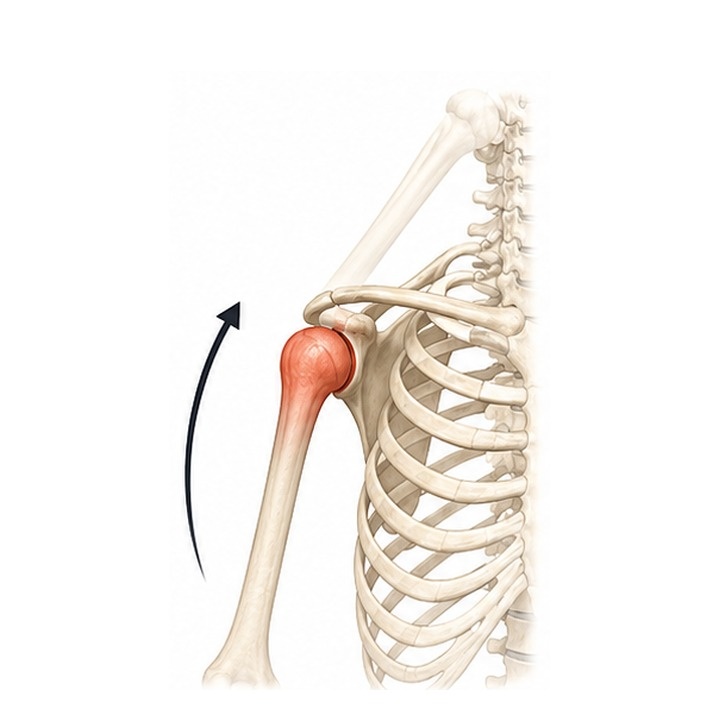
1
Upper arm and shoulder joint
The upper arm moves in the ball-and-socket shoulder joint, also called the glenohumeral joint.
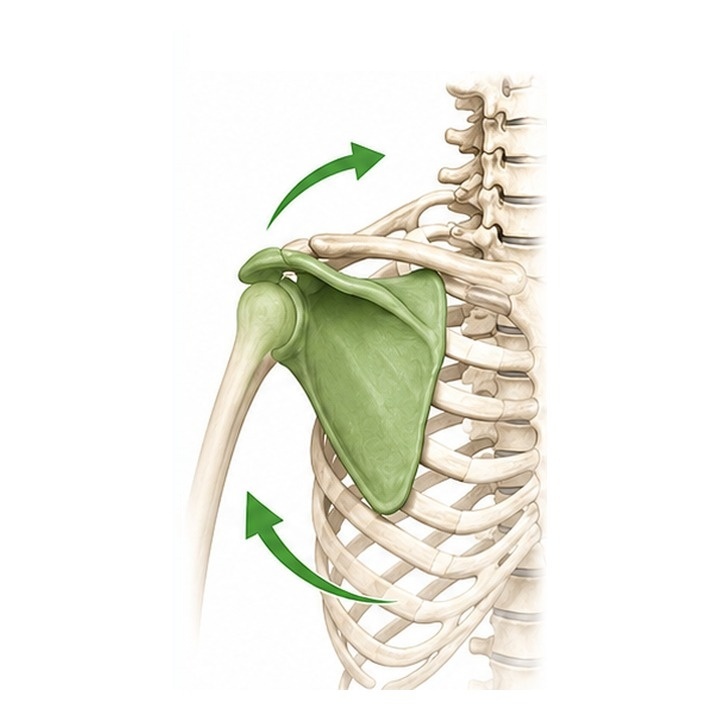
2
Shoulder blade
The shoulder blade, or scapula, rotates upward and glides on the rib cage.
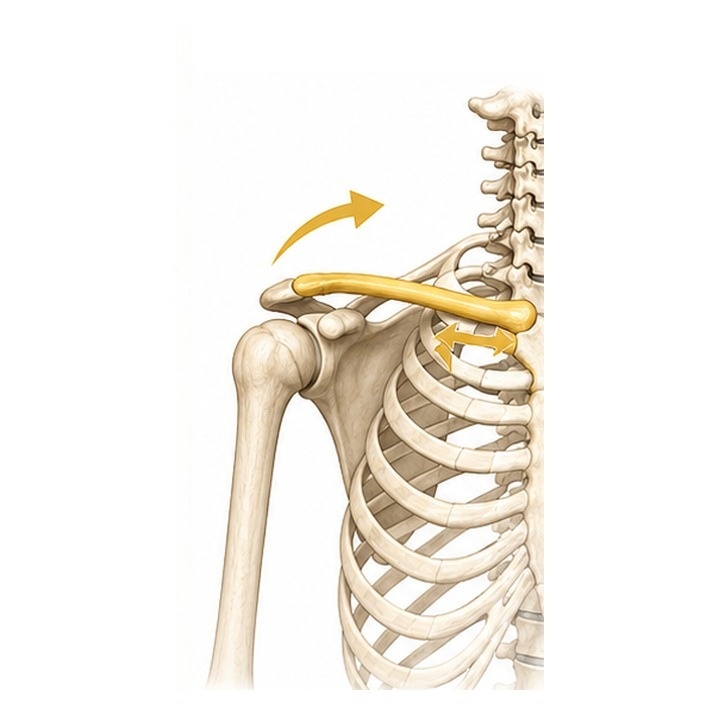
3
Collarbone
The collarbone, or clavicle, also moves through its connections with the shoulder and chest.
4
Combined movement
The upper arm, shoulder blade and collarbone work together to raise the arm.

There is no fixed “correct” ratio. The contribution of each part changes with range, speed, load, support and the individual.
02 — THE WHOLE TASK
The trunk changes the movement problem.
Where the arm begins is influenced by the body beneath it.
The shoulder blade moves on the thorax, so trunk position changes the starting geometry. Reaching distance can change how the arm and trunk share a task.
This does not mean every shoulder problem begins in the back, or that one posture is universally correct.
03 — INFORMATION & VARIATION
Movement is sensed as well as produced.
Control depends on information from vision, touch, muscles, tendons and joints. This includes proprioception: the body’s awareness of position, direction, speed and resistance, which does not depend on vision alone.
A repeated movement is recognisable, but not identical. Variation needs context; it is not automatically an error.
Whether PlyoDyne changes perception, learning or clinical outcomes remains a research question.
04 — SHAPING THE TASK
Change one variable and
the movement problem changes.
Direction
Where the handle is asked to travel.
Range
How far the shaft tilts and how far the handle travels along it—two separate movement variables.
Support
Whether the shaft moves freely, is range-limited or rests on the Range Control Ring.
Position & rotation
Where the hand is relative to the axis and how the keyed assembly turns.
Added mass
Which weights are placed on the weighted handle.
Speed & acceleration
How quickly the movement changes.
These variables interact. A larger range at greater speed with the same added mass is not the same mechanical task.
05 — TRAINING CHARACTERISTICS
Seven characteristics.
One connected task.
1. MOVEMENT CONTROL & FOUNDATION
Balance
Managing the relationship between the body, support and a changing movement task.
Coordination
Organising direction, timing and contribution across connected body segments. Following the travelling hand can also add visual, head and upper-trunk coordination.
Elasticity
Developing elastic and reactive movement progressively through coordinated biomechanical chains.
Stability
Maintaining control while direction, range, support or external demand changes.
2. PERFORMANCE DEVELOPMENT
Power
Producing force through movement, including transitions between deceleration and acceleration.
Speed
Changing movement velocity deliberately while retaining the intended movement quality.
Endurance
Sustaining an appropriate movement task across repeated efforts or longer working periods.
The PlyoDyne methodology uses seven functional training characteristics. They are not seven isolated machine functions: several can be present in the same movement.
Direction, range of movement, support, added mass and velocity can be adjusted progressively. The appropriate combination depends on the individual, the objective and—where relevant—the judgement of a qualified professional.
1
Movement Control & Foundation
Balance, coordination, elasticity and stability describe distinct aspects of movement control. They can be combined within a task and adjusted to the individual objective.
2
Performance Development
Power, speed and endurance describe performance-related demands that can be explored after an appropriate starting point has been established. Their use and progression depend on the individual and the task.
The seven characteristics are interconnected. A PlyoDyne® exercise or training programme can address one or more simultaneously, depending on the goal, setup and the individual.
06 — FOUR TYPICAL PHASES
A progression framework,
not a fixed protocol.
The original methodology groups the seven characteristics into four typical phases. Progression is not automatic or identical for every user; phases may overlap, and the task should be adapted to the person and purpose.
Foundation
Balance · Coordination · Elasticity · StabilityEstablish the movement task and explore control before increasing external demand.
Power
Progressive forceIntroduce greater force demands through deliberate changes in mass, acceleration, range and leverage.
Speed
Acceleration · DecelerationProgress movement velocity only when the selected task can still be performed with the intended control.
Endurance & integration
Sustained combinationsCombine the characteristics over repeated or longer efforts according to the individual objective.
07 — MASS & DEMAND
A small weight change is precise—but not the whole force story.
Added combinations begin at 25 g.
Also depends on acceleration and gravity.
Depends on force and distance from an axis.
Depends on how mass is distributed.
PAIN CHANGES THE QUESTION
Pain is real, personal and not explained by movement alone.
A visible movement pattern does not by itself identify the cause or determine the right response. If a controlled movement task interests you, discuss it with a qualified healthcare professional.
Please do not submit medical records or detailed personal health information. iQQuip cannot provide diagnosis or individual medical advice.
FROM SCIENCE TO THE SYSTEM
A defined environment
for an open question.
PlyoDyne structures external movement variables. It does not prescribe the correct pattern or prove a clinical outcome.
Professional framework