


Flexion & extension · rotation · lateral movement · diagonal movement
BACK & CORE EXERCISES
Back & core exercises with controlled movement
Back and core movements are closely connected. Once the trunk contributes to a movement task, the body coordinates the back, trunk, pelvis, hips and legs rather than using one region in isolation.
iQQuip® approaches back & core training as a configurable movement task. Direction, range, speed, support, body position and inertia can be changed to alter how the trunk contributes to stability, rotation, weight transfer and whole-body control.
One movement system — two support configurations.The exercise principles shown here apply to both PlyoDyne® PRO ONE and PRO WALL. PRO ONE is freestanding; PRO WALL uses a wall-mounted support structure.
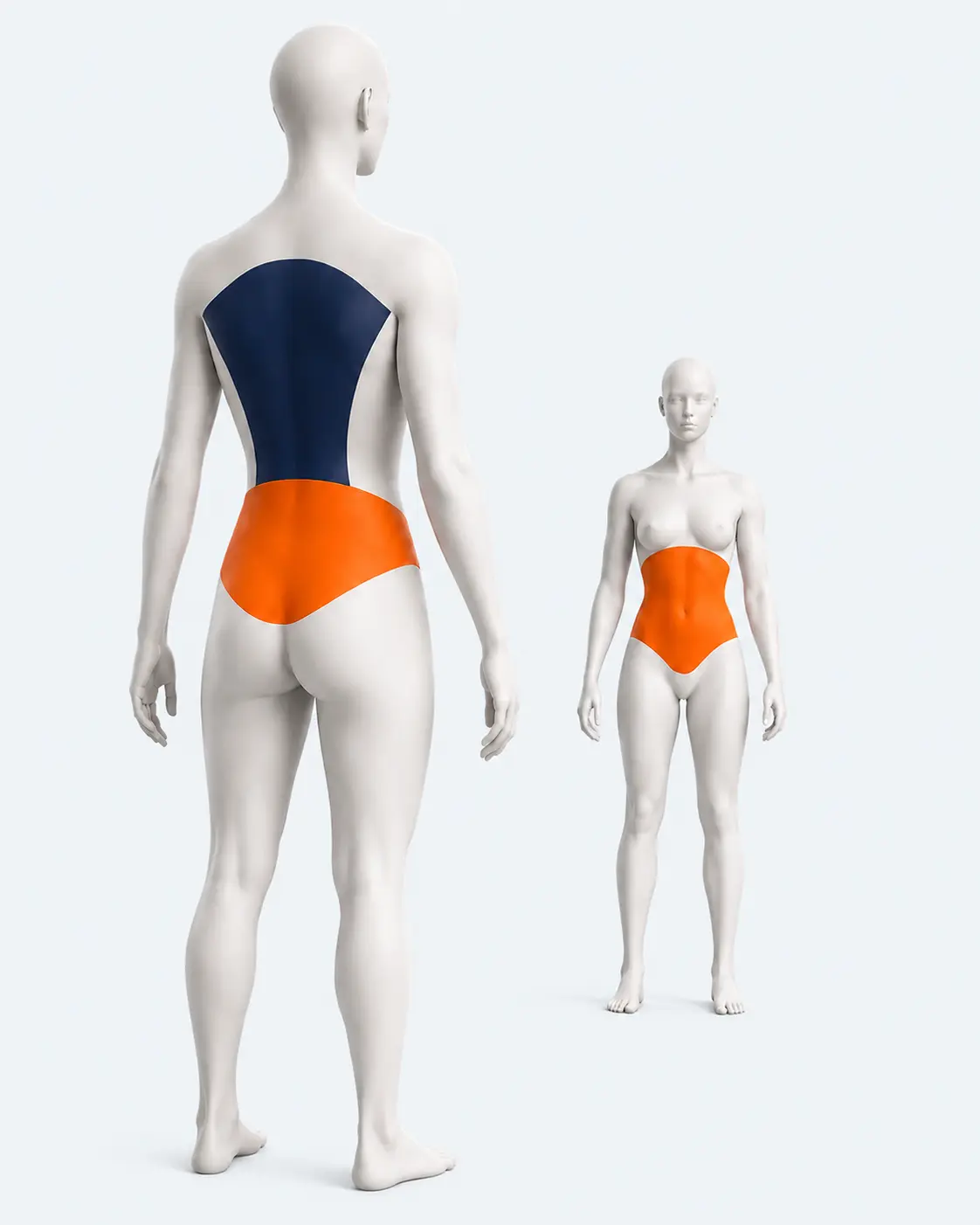
01 — CONNECTED TRUNK MOVEMENT
The back and core work together during movement.
As the trunk contributes to a movement, back and core involvement overlaps. The emphasis can shift according to direction, body position and the objective, but the regions do not operate as isolated exercise systems.
Back and core are therefore treated here as training emphases within one connected movement task.
Stability · rotational control · force transfer · upper/lower-body coordination
StabilityRotationWeight transferDiagonal movementWhole-body coordination
02 — THE PLYODYNE® DIFFERENCE
Back & core movement with PlyoDyne®.
A defining characteristic of PlyoDyne® movement is that the handle travels along the shaft.
As the handle changes position, the shaft can tilt around its fixed flexible joint. When trunk movement, rotation or weight transfer are added, the back, core, hips and legs contribute increasingly to the overall movement task.
The challenge can be changed by varying direction, range, speed, inertia, support and body position.
Handle travel remains fundamental even when trunk movement, rotation or weight transfer is added.
03 — PROGRESSION
Build control before adding complexity.
The same four-level progression applies across the PlyoDyne® exercise system. One-handed control comes first; larger shaft tilt, diagonal movement, trunk contribution, speed and whole-body coordination are added progressively.
Two-handed work is advanced and follows only after sufficient one-handed stability and control have been established.
One-handed control
Learn meaningful handle travel, comfortable range, shaft control, smooth reversal, balance and stability.
Every new user starts here.One-handed movement
Add larger shaft tilt, diagonal movement, trunk involvement, controlled weight transfer and greater movement range.
One-handed movement
Add higher speed, faster reversal, continuous cycles, greater whole-body contribution and increased inertia where appropriate.
Speed must never cause the handle to stop travelling along the shaft.Whole-body movement
Only after sufficient one-handed stability and control. Two-handed movement reduces independent arm movement and increases coordinated contribution through the trunk, hips and legs.
04 — HAND USE
One-handed first. Two-handed later.
PlyoDyne® exercises can be performed one-handed or two-handed. One-handed execution establishes control of the travelling handle, balance and familiarity with the movement system. Two-handed execution is introduced only after sufficient one-handed control and stability have been developed.

1H · ONE-HANDED
One-handed
Use one hand to control the travelling handle. One-handed execution allows the arm to move more independently and is used throughout the foundation, coordinated and dynamic progression.
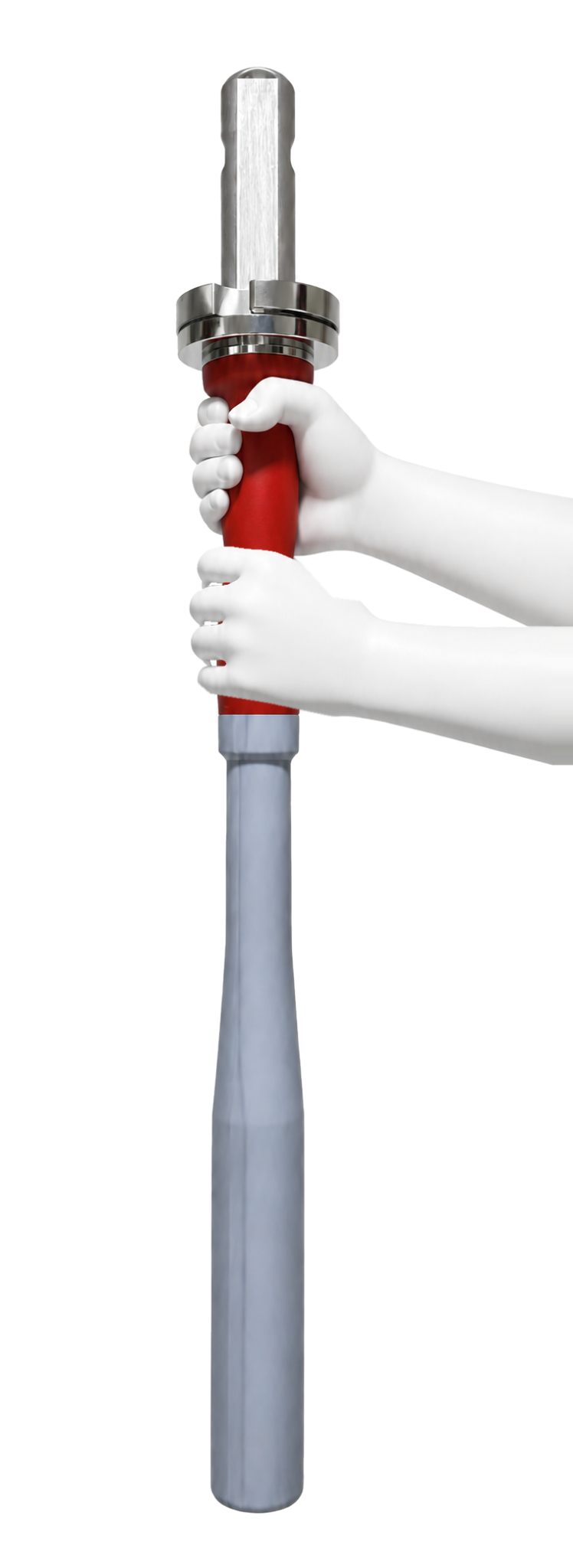
2H · TWO-HANDED
Two-handed
Place both hands securely around the handle. With both hands connected to the same handle, independent arm movement is reduced and the movement requires greater coordination through the whole body.
Establish one-handed control before progressing to two-handed execution.
05 — ONE-HANDED STARTING POSITION
Use the marked exercise-area position.
Use this starting foot position for all one-handed exercises unless an exercise specifically states otherwise.
The right- and left-handed starting positions are mirrored. Begin roughly in the position shown and adjust your stance slightly if needed to remain comfortable and balanced.
The feet stay in the established starting positions during the one-handed exercises described here, while pressure and weight distribution through the feet can change naturally with the movement.
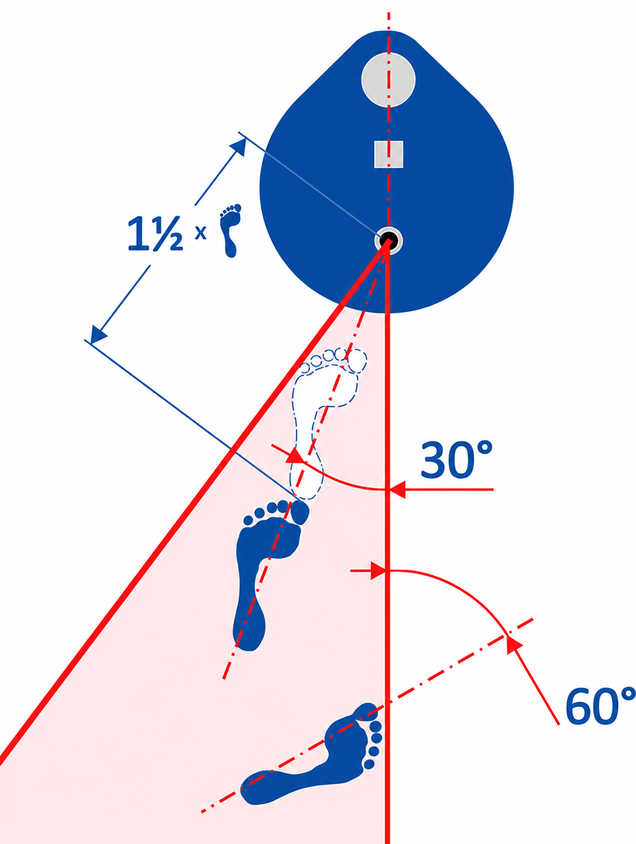
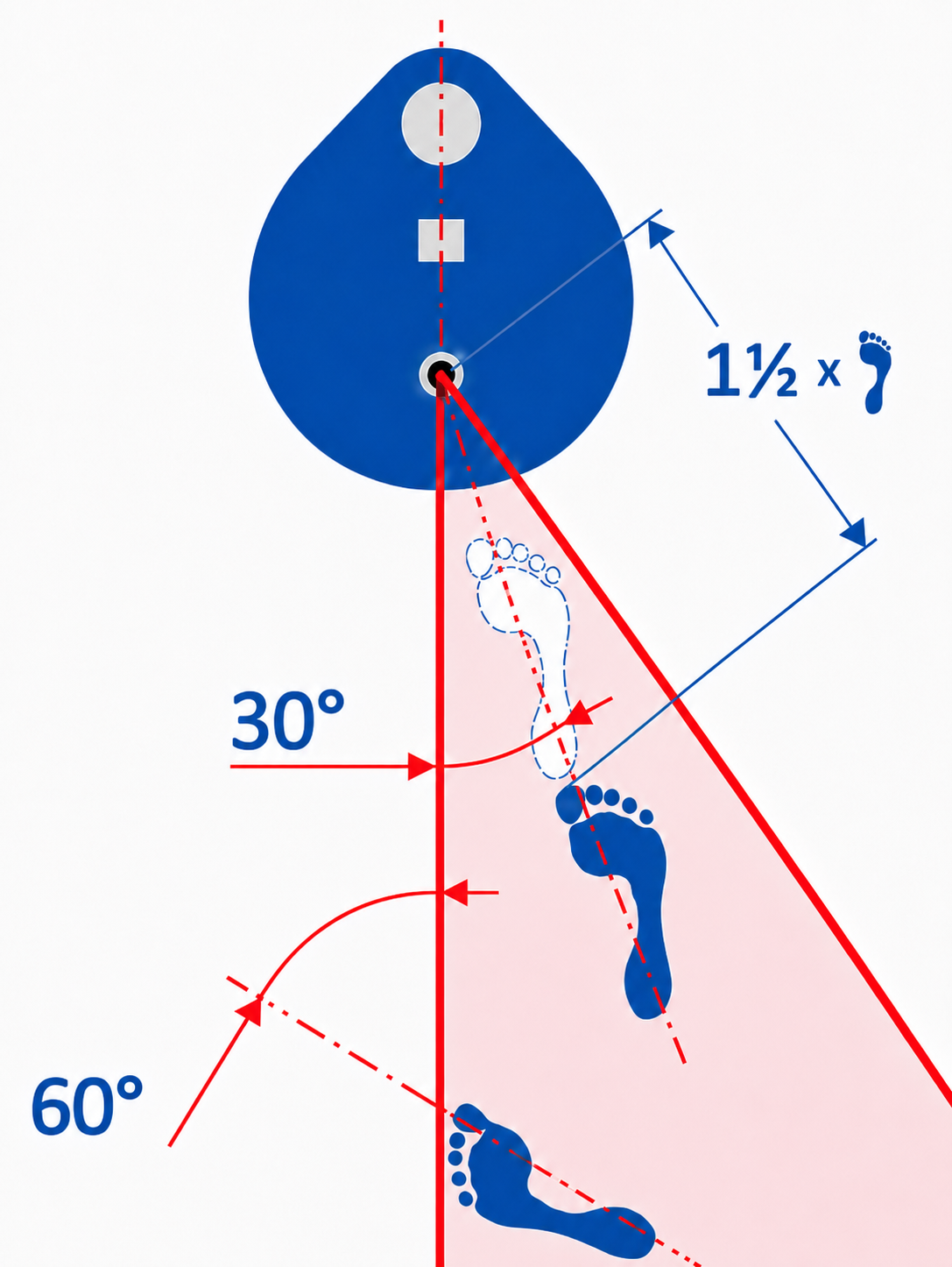
Indicative starting positionThe marked foot positions and dimensions are a guide only. Adjust slightly where necessary to remain comfortable and balanced.
06 — EXECUTION
Two progression pathways. One movement principle.
Both executions begin with controlled movement. The movement pattern remains the same; the way it is progressed reflects the objective.
Performance progression
Begin without additional load. Once continuous handle travel, balance and control are established, progression can include repetitions and sets, range, speed, active push/pull, acceleration and deceleration, additional load, power and increasingly dynamic reversals.
repetitions & sets → range → speed → active push/pull → acceleration/deceleration → additional load → power
Movement & recovery progression
M execution is performed without added weight. Progression can include repetitions and sets, comfortable range, coordination, rhythm, speed, active push/pull, acceleration and deceleration, faster controlled reversals and eventually power where appropriate.
repetitions & sets → range → coordination → rhythm → speed → active push/pull → controlled acceleration/deceleration
S and M are not different exercises. They are different ways of progressing the same movement. Both begin with control; progression thereafter reflects the objective of the execution.
07 — DYNAMIC MOVEMENT
From controlled travel to dynamic movement.
As speed increases, the handle can increasingly be pushed and pulled actively. The user can accelerate, decelerate and redirect the travelling handle while the whole body contributes to generating and absorbing the movement.
Upward travel reverses.
The upward travel phase reaches its outer limit and changes into travelling down. Incoming speed can be actively decelerated before the movement is redirected.
Downward travel reverses.
The downward travel phase reaches its outer limit and changes into travelling up. The body can absorb and redirect the movement into the next cycle.
Absorb and redirect the movement dynamically.
As speed and power increase, the travelling-up end point, the travelling-down end point, or both can develop a plyometric character. The incoming movement is absorbed and redirected rapidly rather than brought to a hard stop, while continuous handle travel along the shaft is maintained.
Create more tension when the objective requires it.
At advanced levels, the support handles can be used actively rather than only for stability. Greater upper-body tension and stronger contraction/expansion patterns can enable more forceful push/pull actions, acceleration, deceleration, redirection, speed and power. This is particularly relevant to advanced S execution.
Increasing speed, power or reversal intensity must never cause the handle to stop travelling along the shaft. The two end points are reversal points, not hard stops.
08 — MOVEMENT EXAMPLES
Back & core movement examples.
The examples progress from one-handed whole-body follow through diagonal and dynamic movement to advanced two-handed execution.
BE AWARE
When first using PlyoDyne®, the handle may feel as if it moves by itself or pulls unexpectedly. This is a normal response to the combined movement and inertia. Begin slowly and maintain control; the sensation usually becomes familiar after a few sessions.
SELECT EXERCISESelect an exercise below to view its movement instructions.
01
Whole-Body FollowControlled low-to-high travel while following the handle with the eyes
Introduce whole-body participation while retaining the fundamental controlled-travel movement. The key difference from the shoulder example is that you follow the handle with your eyes, allowing movement to develop naturally through the head, shoulders, trunk, hips, legs and feet.
Start
- use the standard one-handed starting position
- begin with the handle comfortably in front
- for S, begin without additional load
- perform the first repetition very slowly: approximately 4–5 seconds travelling up and 4–5 seconds travelling down
- establish balance before increasing range
Move
- slide the handle smoothly upward along the shaft
- follow the handle with your eyes
- allow the head and shoulders to follow the gaze
- allow the trunk, hips, legs and feet to contribute naturally
- allow weight transfer as required
- progressively explore a larger comfortable range
Return
- reduce speed approaching the travelling-up end point
- reverse smoothly
- continue following the handle with your eyes
- guide the handle continuously back down the shaft
- allow the whole body to return with the movement
Focus
- continuous handle travel
- eyes following the handle
- coordinated movement through the whole body
- smooth weight transfer
- comfortable range
- balance and controlled reversal
Avoid
- moving only the arm while deliberately fixing the rest of the body
- creating the movement mainly through the lower back
- forcing rotation or range
- abrupt reversal
- losing balance
- increasing speed before whole-body coordination is established
S execution — Performance progression
Begin without additional load. Once the movement is controlled, progress through repetitions and sets, greater range, rhythm and speed. Later progression can introduce increasingly active push/pull, acceleration/deceleration, additional load and higher performance demand.
M execution — Movement & recovery progression
M execution is performed without added weight. Progress through repetitions and sets, comfortable range, coordination, rhythm and increasingly fluent whole-body movement. Speed, active push/pull, acceleration/deceleration and eventually power can be introduced progressively.
02
Diagonal Whole-Body TravelControlled diagonal travel with rotation and weight transfer
Build on Whole-Body Follow by adding a larger diagonal movement path. Follow the handle with your eyes and allow the movement to develop through the entire body while progressively exploring the maximum range that remains comfortable.
Start
- use the standard one-handed starting position
- begin with the handle comfortably in front
- for S, begin without additional load
- establish the diagonal movement slowly
- begin with a range that can be controlled comfortably
Move
- keep the handle travelling continuously along the shaft
- move through a controlled diagonal path
- follow the handle with your eyes
- allow natural rotation through the trunk and hips
- allow weight transfer through the legs and feet
- progressively extend towards the maximum comfortable range
Return
- reduce speed approaching the travelling-up end point
- reverse the diagonal movement smoothly
- continue following the handle with your eyes
- allow the whole body and weight transfer to follow the returning movement
- maintain continuous handle travel
Focus
- continuous handle travel
- eyes following the handle
- coordinated whole-body movement
- diagonal movement and natural rotation
- smooth weight transfer
- maximum comfortable range
- balance throughout both directions
Avoid
- deliberately fixing the trunk, hips, legs or feet
- trying to create rotation primarily through the lower back
- forcing the outer range
- losing balance to obtain more range
- stopping handle travel while changing direction
- increasing speed before the diagonal movement is controlled
S execution — Performance progression
Begin without additional load. Progress through repetitions and sets, greater range, rhythm and speed. Once the complete diagonal movement remains controlled, increasingly active push/pull, acceleration/deceleration and later additional load can be introduced.
M execution — Movement & recovery progression
M execution is performed without added weight. Progress through repetitions and sets, comfortable range, coordination, rhythm and increasingly fluent whole-body diagonal movement. Speed, active push/pull and acceleration/deceleration can be developed progressively.
03
Dynamic Diagonal TravelContinuous dynamic diagonal whole-body movement
Develop the controlled diagonal movement into a continuous dynamic whole-body cycle. Follow the handle with your eyes while rhythm, speed, acceleration and deceleration increase progressively. At higher speeds, increasingly active push and pull can be used to drive and control the travelling handle.
Start
- use the standard one-handed starting position
- for S, begin without additional load
- establish the diagonal path slowly
- follow the handle with your eyes
- build rhythm before increasing speed
Move
- keep the handle travelling continuously along the shaft
- maintain the diagonal movement path
- allow coordinated movement through the head, shoulders, trunk, hips, legs and feet
- allow natural rotation and weight transfer
- progressively extend towards the maximum comfortable range
- use increasingly active push and pull as the movement becomes more dynamic
Travelling-up end point
- control incoming upward speed
- actively decelerate where required
- allow the body to absorb the change of direction
- redirect smoothly into travelling down
- avoid a hard stop
Travelling-down end point
- control incoming downward speed
- allow the trunk, hips, legs and feet to contribute to deceleration
- redirect smoothly into the next travelling-up phase
- maintain continuous handle travel
Focus
- continuous handle travel
- eyes following the handle
- whole-body coordination
- maximum comfortable range
- rhythm
- active push and pull
- acceleration and deceleration
- control at both reversal points
Avoid
- increasing speed before the diagonal movement is controlled
- forcing range
- creating rotation mainly through the lower back
- allowing either reversal to become an uncontrolled stop
- applying so much force that handle travel deteriorates
- losing balance in pursuit of speed or power
S execution — Performance progression
Begin without additional load. Progress through repetitions and sets, range, rhythm, speed, increasingly active push/pull and greater acceleration/deceleration. Additional load, power and advanced support-handle use can follow. At higher levels, either or both reversals may develop a plyometric character.
M execution — Movement & recovery progression
M execution is performed without added weight. Progress through repetitions and sets, range, coordination, rhythm, speed, active push/pull and increasingly controlled acceleration/deceleration. Faster reversals and eventually greater power can be introduced where appropriate.
Two-handed progression
04
Two-Hand Whole-Body TravelControlled two-handed whole-body movement
Introduce controlled two-handed travel after sufficient one-handed stability, balance and handle control have been established. With both hands connected to the same handle, independent arm movement is reduced and the whole body becomes more involved in organising the movement.
Start
- use the two-handed starting position
- choose either hand arrangement
- for S, begin without additional load
- begin slowly and establish balance
- start with a moderate movement range
Move
- keep the handle travelling continuously along the shaft
- follow the handle with your eyes
- allow the head, shoulders, trunk, hips, legs and feet to respond naturally
- allow rotation and weight transfer through the whole body
- progressively extend towards the maximum comfortable range
- maintain secure control with both hands
Return
- reduce speed approaching the travelling-up end point
- allow the whole body to accommodate the change of direction
- reverse smoothly into travelling down
- continue following the handle with your eyes
- maintain coordinated whole-body movement
Focus
- continuous handle travel
- coordinated two-handed control
- eyes following the handle
- whole-body rotation and weight transfer
- maximum comfortable range
- balance and smooth reversals
- both grip configurations across multiple sets
Avoid
- relying mainly on the arms
- deliberately fixing the trunk, hips, legs or feet
- forcing range
- losing balance to obtain more movement
- turning either end point into a hard stop
- introducing two-handed execution before sufficient one-handed control
S execution — Performance progression
Begin without additional load. First establish two-handed control through both grip arrangements. Progress through repetitions and sets, greater range, rhythm and speed; increasingly active push/pull, acceleration/deceleration and later additional load can follow.
M execution — Movement & recovery progression
M execution is performed without added weight. Progress through repetitions and sets, comfortable range, coordination, rhythm and increasingly fluent whole-body movement. Speed, active push/pull and controlled acceleration/deceleration can be introduced progressively.
05
Dynamic Two-Hand TravelAdvanced continuous two-handed whole-body movement
Develop the controlled two-handed movement into a continuous, increasingly dynamic whole-body action. Follow the handle with your eyes while rhythm, range, speed, acceleration and deceleration increase progressively. At higher speeds, the handle is actively pushed and pulled to generate and control the movement.
Start
- use the two-handed starting position
- choose either hand arrangement
- for S, begin without additional load
- begin slowly and establish balance and rhythm
- start with a moderate range before progressing towards the maximum comfortable range
Move
- keep the handle travelling continuously along the shaft
- follow the handle with your eyes
- allow coordinated movement through the entire body
- allow rotation and weight transfer to develop naturally
- progressively extend towards the maximum comfortable range
- use increasingly active push and pull as the movement becomes more dynamic
Travelling-up end point
- control incoming upward speed
- actively decelerate where required
- allow the whole body to absorb the change of direction
- redirect smoothly into travelling down
- maintain continuous handle travel
Travelling-down end point
- control incoming downward speed
- allow the trunk, hips, legs and feet to contribute strongly to deceleration
- redirect smoothly into the next travelling-up phase
- maintain balance and continuous handle travel
Focus
- continuous handle travel
- coordinated two-handed whole-body movement
- eyes following the handle
- maximum comfortable range
- rhythm
- active push and pull
- acceleration and deceleration
- powerful but controlled reversals
- alternate hand arrangements across multiple sets
Avoid
- relying mainly on the arms
- fixing the lower body unnecessarily
- forcing range
- increasing speed before two-handed coordination is stable
- allowing either reversal to become a hard stop
- applying so much force that handle travel deteriorates
- sacrificing balance for speed or power
S execution — Performance progression
Begin without additional load. Progress through repetitions and sets, maximum comfortable range, rhythm, speed, increasingly active push/pull, acceleration/deceleration and faster reversals. Additional load, higher power and advanced support-handle use can follow. At advanced levels, either or both end points may develop a plyometric character.
M execution — Movement & recovery progression
M execution is performed without added weight. Progress through repetitions and sets, comfortable range, coordination, rhythm, speed, active push/pull and increasingly controlled acceleration/deceleration. Faster reversals and eventually greater power can be introduced where appropriate.
09 — PROFESSIONAL GUIDANCE
Exercise and professional guidance.
Pain, including back pain, an injury or a diagnosed condition can influence how a person moves, loads the body and responds to exercise.
If you experience pain, have an injury or have been diagnosed with a condition that affects movement, discuss exercise and movement training with a qualified healthcare professional before starting or changing a programme.
PlyoDyne® does not diagnose or treat pain or medical conditions. It provides a configurable environment for controlled movement training. A qualified professional can determine whether this type of training is appropriate for an individual situation.
10 — FOR PROFESSIONALS
Configure the movement to the objective.
Physiotherapists, rehabilitation professionals and other qualified movement specialists can use PlyoDyne® to configure movement variables such as direction, range, speed, support, body position and inertia according to the individual objective and situation.
Explore professional applications